

The short answer: Hvar is a destination, not a base
There is no yacht charter base on the island of Hvar. Not one of the fleet directories we checked lists a sailing yacht or catamaran that is handed over on Hvar on a Saturday afternoon. You charter from Split, Trogir, Kaštela, Seget, Agana or Rogoznica, and you sail to Hvar — a little over twenty nautical miles, four hours under sail, half that under power. Everything written about "yacht charter Hvar" is really about a week that starts somewhere else.
That is not a technicality. It changes what you should be asking for. The question is not which boat is on Hvar, because none is. The question is which boat is free that week on the mainland, and whether the berths you want on the island are open, seasonal, or already gone by lunchtime.
Six fleet directories, none of them on Hvar
We went through the base lists of the operators that publish them. BooknSail lists twelve bases in Croatia. Angelina lists fourteen. Ultra Sailing lists four. Dream Yacht Charter lists three. ACI's own charter arm lists exactly one — ACI Split. Sunsail runs Croatia out of Dubrovnik and Marina Agana. Add them together, strip the duplicates, and the map is the same shape every time: Pula and Pomer in the north, Punat, Zadar and Šibenik in the middle, then the dense cluster around Split — Kaštela, Seget, Trogir, ACI Split, Kremik, Rogoznica — and Dubrovnik at the bottom. Hvar is in none of them.
What Hvar does have is small boats. A search of one large marketplace returns 131 vessels listed on the island: 116 motorboats, 7 motor yachts and 8 sailing boats, most of them hourly or daily rentals out of Hvar town, Stari Grad and Jelsa. That is a day-trip market, not a charter market. If you want a crewed yacht for a week, it comes from the mainland.
The practical consequence is a planning one. Your week is bought in Split or Trogir, and Hvar is a night or two inside it. Which means the interesting decisions are not about the island at all — they are about where you start, and what you have booked for the nights you are there.
What one night in Hvar town harbour actually costs
Hvar's waterfront is not a marina. It is a town port, run by Nautički centar Hvar, a company owned by the Town of Hvar acting for the county port authority. It publishes a price list, and the price list is unusually clear — clearer, as it turns out, than the marinas around it.
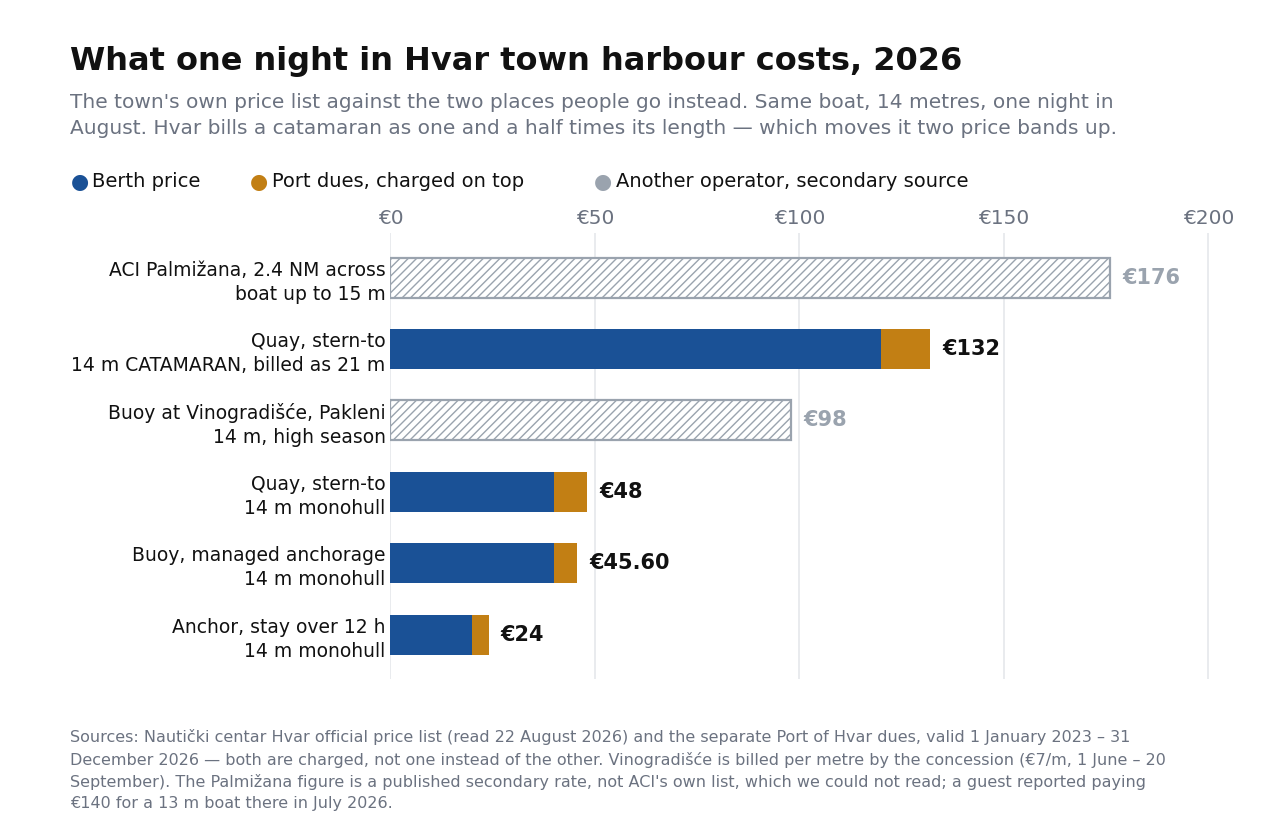
For a 14-metre monohull, one night stern-to on the quay is €40. That price includes the mooring and unmooring, electricity, drinking water and the removal of two 90-litre bags of waste. A buoy in the managed anchorage is the same €40. Lying at anchor for more than twelve hours is charged at half the quay rate, so €20.
Compare that with the marina 2.4 nautical miles across the channel. ACI Palmižana, on the north-east side of Sv. Klement, is the postcard berth of the Pakleni islands — and a published summer rate for a boat up to 15 metres there is €176. A guest recorded paying €140 for a 13-metre boat in July 2026. Neither figure is ACI's own price list, which we could not read; both are several times the town's rate for a comparable boat.
The wild option is not the cheap one either. The buoy field in Vinogradišće, the bay on the far side of Sv. Klement with the restaurants and the botanical garden, is billed per metre: €7 per metre a night between 1 June and 20 September, €5 outside that. For a 14-metre boat that is €98 — more than twice what the town quay charges, for a mooring in a bay.
One more thing about Palmižana, because it catches people out on arrival: there are two of them. The ACI marina sits in the cove on the north-east side of Sv. Klement. The Palmižana of the photographs — the beach, the restaurants, the botanical garden — is Vinogradišće bay on the south side. They are five minutes apart on foot through the pines, and they bill you on completely different principles: the marina by boat length band, the bay by the metre.
Getting into either takes a little care. The southern approach between Borovac and Sv. Klement carries less than five metres of water, and Baba Rock, marked by a black-and-red column with two spheres, only shows at low tide. ACI works channel 17 and asks you to call at least thirty minutes before you enter. From Hvar town a taxi boat runs the crossing in about ten minutes in season, which is the usual answer for a crew who want dinner on one side and their berth on the other.
So the ranking most crews assume — town expensive, marina cheaper, bay cheapest — is upside down at Hvar. The town is the cheap berth. The bay is the expensive one.
The catamaran clause almost nobody reads
One line in the Hvar price list is worth more than the rest of it put together: catamarans are charged at 1.5 times the vessel's length.
Work that through. A 14-metre catamaran is billed as a 21-metre boat. That does not nudge it up a band — it jumps it two. The 10-to-14.99-metre band is €40. The 15-to-19.99 band is €60. The 20-to-24.99 band, where a 14-metre cat lands, is €120. Add the port dues that go with a 21-metre boat and the night comes to €132, against €48 for a monohull of exactly the same length.
The multiplier bites hardest right where the charter fleet is thickest. A 12-metre catamaran counts as 18 metres, so €60 instead of €40. A 13.5-metre cat counts as 20.25 metres and crosses into the €120 band — six metres of paper, and the price triples.
Nobody hides this. It is printed on the price list. It is simply that the crew reading a route plan in February is comparing boats by charter fee and cabin count, and the multiplier lives in a document they will not open until August.
Two bills, not one
The other thing about Hvar is that the berth price is not the whole invoice. There is a second document — the Port of Hvar dues list, valid from 1 January 2023 to 31 December 2026 — and it is charged on top.
For a boat in the 10-to-15-metre band, the quay due is €8 a day. On a buoy it is €5.60. At anchor it is €4. There are two smaller line items in the same table, a shoreline charge of €0.26 a day and a berthing charge of €2.65. None of it is large. All of it is separate, and it is the reason a crew who read "€40" on one page arrives at a number that is not €40.
The dues list is also the one document on the Dalmatian coast with a fixed end date printed on it. It runs to the last day of 2026. The berth prices above it can move; the dues cannot, until they are replaced.
Nobody agrees how big Palmižana is
Here is a small thing that tells you something large. We tried to find out how many berths ACI Palmižana has.
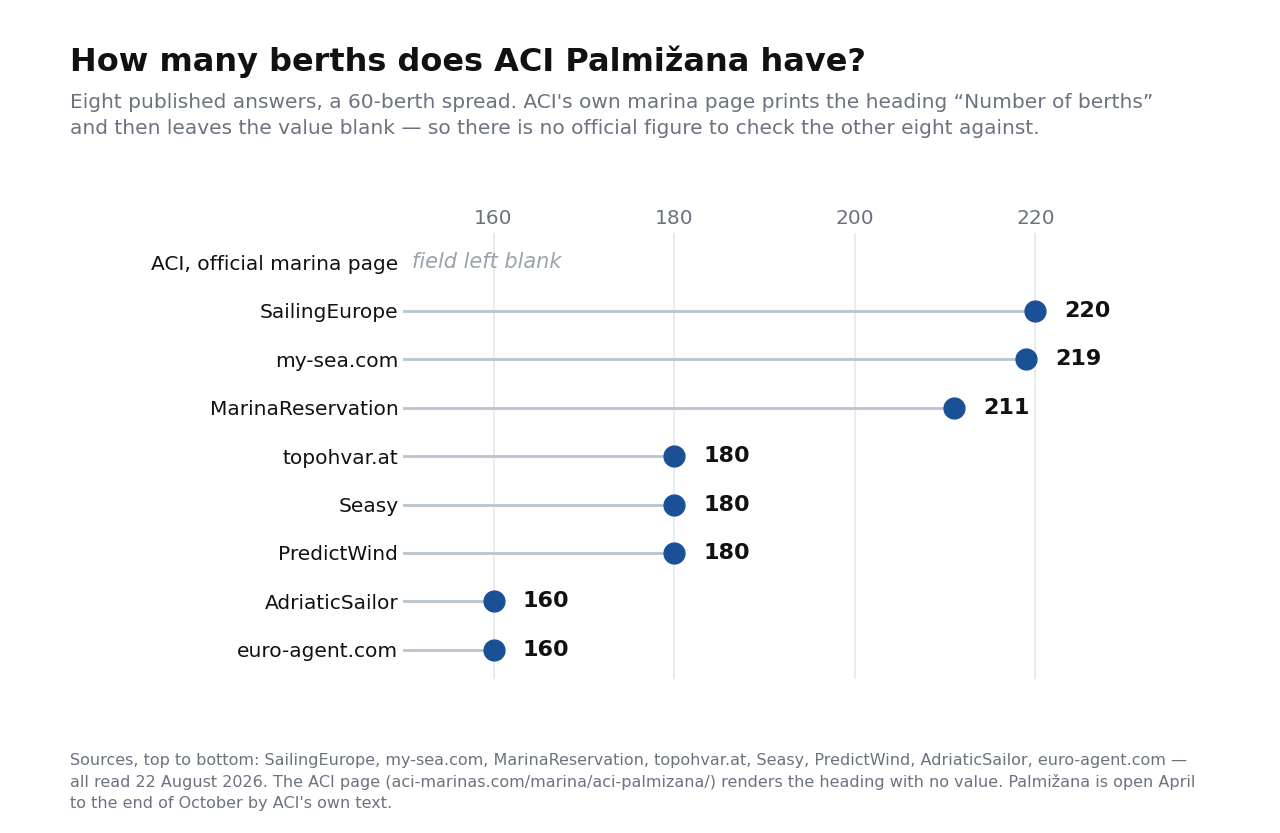
Eight published sources give eight answers, and they span sixty berths: 160, 160, 180, 180, 180, 211, 219 and 220. ACI's own marina page prints the heading "Number of berths" and then renders nothing after it. There is no official figure to settle the argument with.
The same happens at Vrboska: the Vrboska tourist board says 85 berths, one marina database says 125, another field on the same database says 114. And it happens with the distance from Split to Hvar, which is 22.4 nautical miles according to one route planner and 25 according to another. And with Hvar to Korčula, which four sources put at 25, 32, 33 and 51.6 nautical miles — a spread of more than a full sailing day.
This is the part of Croatian charter planning that no amount of reading fixes. The numbers on the open web are copied between sites, aged, and occasionally invented. The only cure is a phone call to the marina for the week you actually want, and it is exactly the kind of unglamorous work that separates a route that holds together from one that does not.
What is open, and when
Season dates matter more on Hvar than almost anywhere else in Dalmatia, because the island's two marinas do not keep the same calendar.
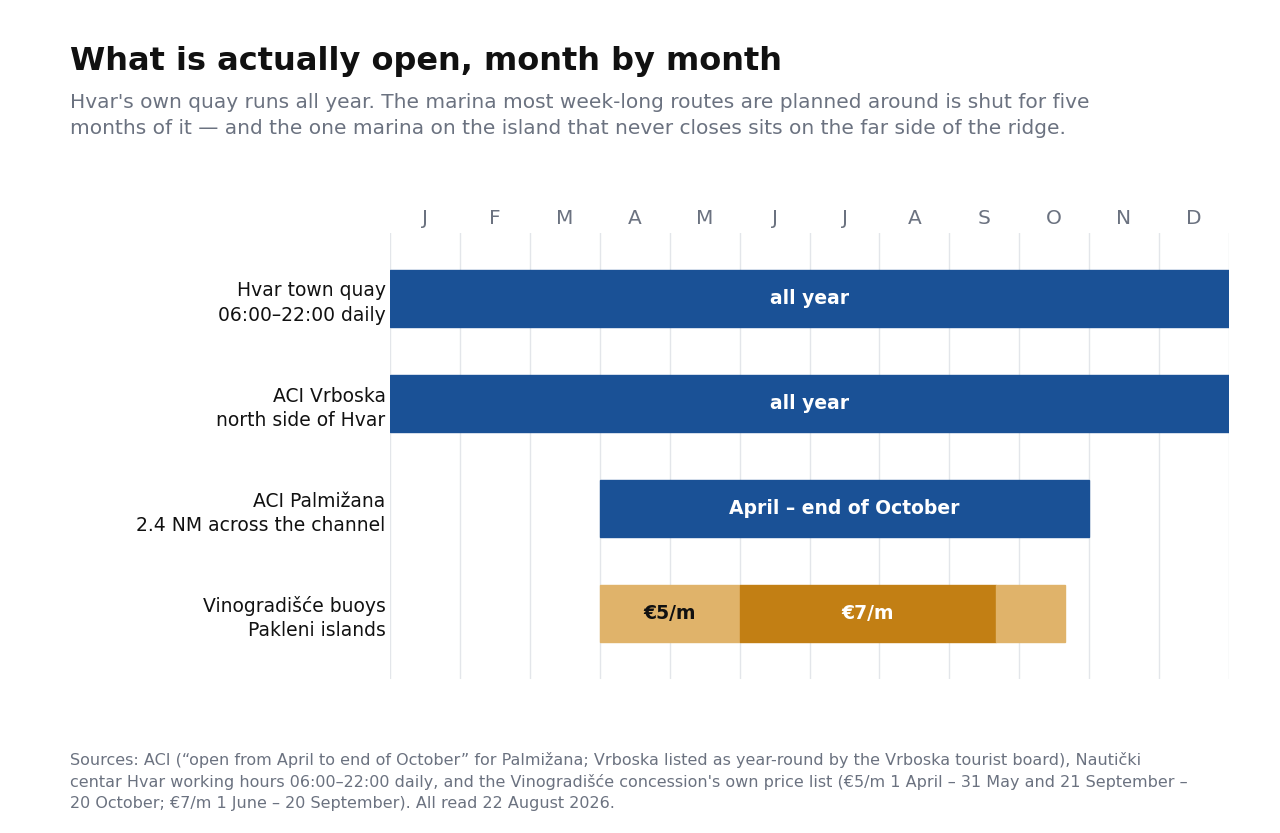
ACI Palmižana is open, in ACI's own words, from April to the end of October. For five months it is not there. ACI Vrboska is open all year — but Vrboska is on the north coast, at the end of a long narrow inlet behind the Glavica peninsula, twenty road kilometres and a mountain ridge away from Hvar town. The only marina on the island that never closes is on the side of the island most people are not going to.
The Vinogradišće buoy field runs from 1 April to 20 October, with its high-season rate between 1 June and 20 September. Hvar's own quay works every day of the year, 06:00 to 22:00, on VHF channel 9.
So a May charter and an October charter are not the same holiday with different weather. In late October, Palmižana has shut, the buoys have come out of Vinogradišće, and what is left on the island is the town quay and a marina on the wrong coast.
Getting a guest on or off the island mid-week
Charter weeks rarely start with everyone in one place. Someone flies in on the Monday, someone has to leave on the Thursday, and Hvar is the island where that is easiest to arrange — as long as you use the right port.
The fast catamarans from Split to Hvar town take between 50 minutes and an hour and five, with as many as nineteen sailings a day in August. Three companies run the route and they do not publish a joint timetable, which is why a ticket is quoted at €23 on one site and €25 on another. The last summer departure is where it gets awkward: one operator's own timetable ends the day at 18:50, a second source says 19:15, a third says 20:00. If a guest's flight is late, the difference between those three numbers is whether they sleep on the boat or in Split.
The car ferry is the slower, more forgiving option. Split to Stari Grad takes about an hour and fifty minutes, costs €8.40 for an adult in high season and €47.60 for a car up to five metres, and the last sailing leaves at 20:30. But Stari Grad is not Hvar town. It is twenty kilometres and a ridge away, about twenty minutes by road, and a crew who assumed the ferry lands them at the harbour have an unplanned drive in front of them.
Then there is the route that looks clever and is not. The shortest ferry to Hvar is Drvenik to Sućuraj, thirty-five minutes across the channel. Sućuraj is at the far eastern tip of the island. From there to Hvar town is seventy-seven kilometres along the D116, which runs 77.9 kilometres end to end — an hour and a half at best, on a road that was not built for it. It is the correct answer only if you are coming down the coast by car and the eastern end of Hvar is where you want to be.
The noon rule, and the sirocco rule
Two constraints govern a Hvar night, and neither is a price.
The first is time. Hvar's quay is 313 metres long in total — 115 metres of it deep enough for larger vessels and 198 metres for smaller ones. That is not much waterfront for the most visited town on the Adriatic. One long-standing local guide puts it plainly: after twelve o'clock there are usually no free moorings or buoys left, and roughly half of the boats that come into the harbour do not find a place. A charter week that plans to arrive at Hvar at six in the evening in August is not planning a berth; it is planning to look for one.
The second is wind. Hvar's harbour is safe in the bura. In the sirocco it is not: the swell comes straight in and mooring on the shore is closed. A southerly forecast does not make the island unreachable — it makes the town quay unusable, and the answer is on the other side of the channel or the other side of the island, decided the day before, not at dusk.
Two smaller things worth knowing before you tie up. The port rules ban noise above 60 decibels and ban swimming inside the harbour — in the town with the loudest reputation in Croatia. And a booking cancelled less than 48 hours before arrival is charged in full, where ACI, by contrast, refunds 80 per cent if you cancel at least 24 hours out and keeps 20 as a handling fee. Two ways of moving one boat, two entirely different cancellation risks.
How we plan a week with Hvar in it
Everything above points the same way. Hvar is not a boat you book; it is a night you have to earn, in the middle of a week that starts on the mainland.
So the way we work is the other way round from a boat listing. You tell us the week, how many people, how many cabins, and whether you want a crew. We come back with what is genuinely free that week across the Split and Trogir bases — not a catalogue photo of a yacht that may have been chartered out in January — and with the berths on the island already checked for the nights you would be there: what the town quay can take at your length, whether your catamaran is going to be billed as a 21-metre boat, whether Palmižana is even open in your month.
That is the whole service. Not a hull pushed at you, but the boring half of the trip done properly: the right boat for the week you have, the berths confirmed, the route built around what the wind does rather than what a route planner copied from another route planner.
Send us your dates and the size of your crew and we will come back with the boats that are actually available, what they cost that week, and where you would sleep each night. If you would rather talk it through first, our concierge team takes it from there, and you can see the kind of yachts we work with on our charter page.