

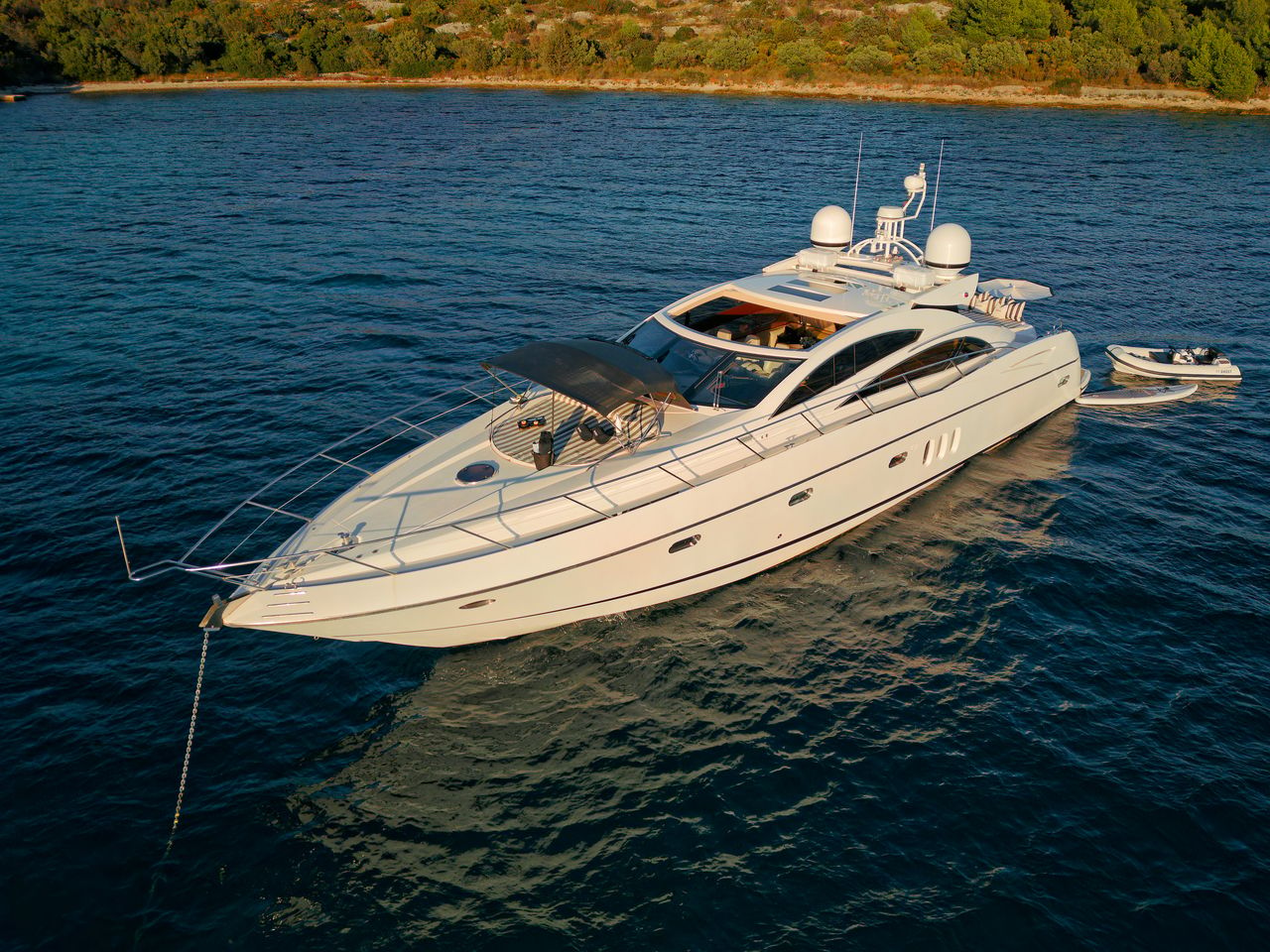
A crewed motor yacht chartered out of Split costs between €5,900 and €21,200 for the week in 2026, sleeps six or seven guests in two or three cabins, carries at least one professional crew member, and can be booked for as little as three days. Those four numbers answer most of what people came here to ask.
What follows is the rest of it: what the price does across the season, which of the three marinas around Split you will actually be standing on, and — the part almost nobody puts in writing — how far a boat that cruises at twenty knots gets you compared with one that sails at six.
What a week actually costs in 2026
Below is a real, published 2026 price calendar for eight crewed motor yachts working out of Split — not an estimate and not a range scraped from listing sites, but the rates a single operator actually charges. Most Croatian charter sites make you send an enquiry before they will tell you whether you are in the right conversation at all, so a like-for-like set of eight is worth more than a hundred "from €X" headlines. It is listed by specification rather than by boat name, because what you are buying at each level is a length, a build year and a number of berths.
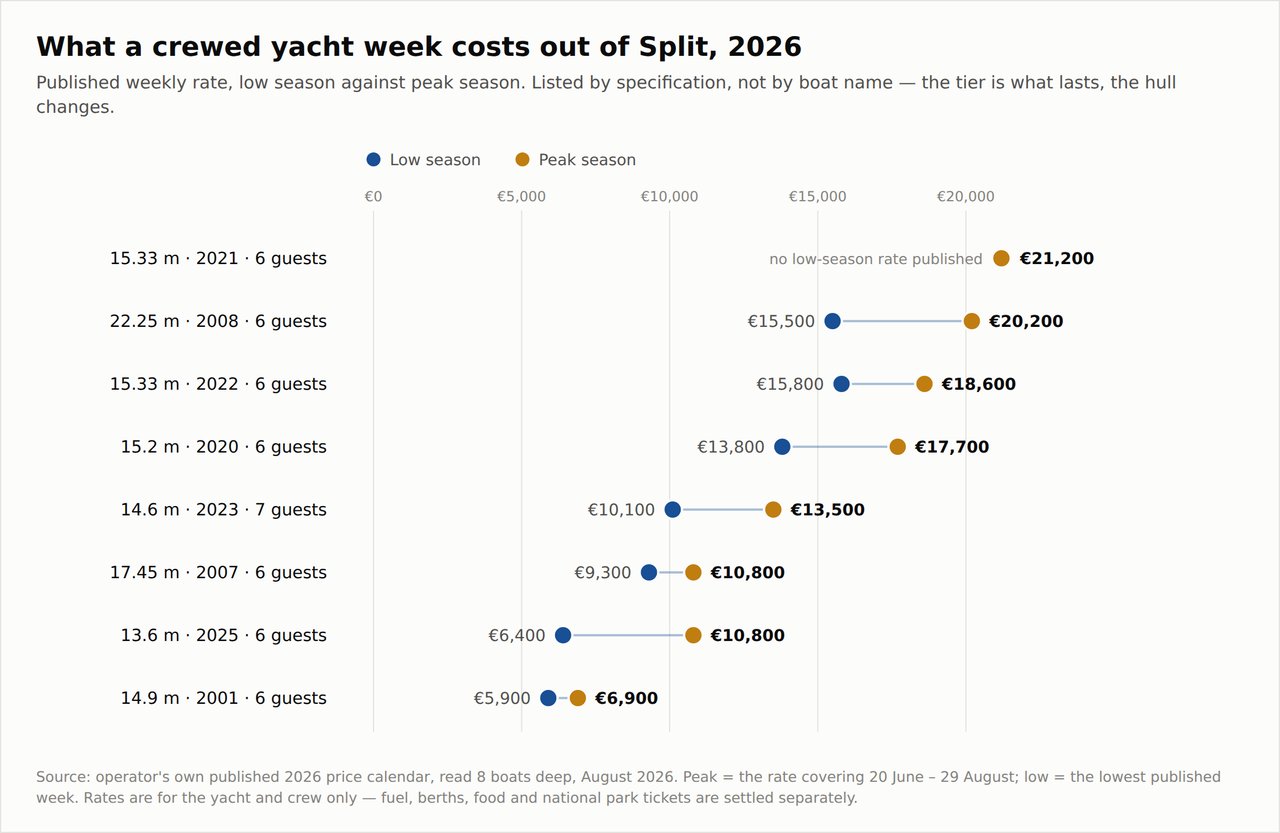
14.9 m, built 2001, 6 guests — €5,900 low week, €6,900 peak week
13.6 m, built 2025, 6 guests — €6,400 low week, €10,800 peak week
17.45 m, built 2007, 6 guests — €9,300 low week, €10,800 peak week
14.6 m, built 2023, 7 guests — €10,100 low week, €13,500 peak week
15.2 m, built 2020, 6 guests — €13,800 low week, €17,700 peak week
22.25 m, built 2008, 6 guests, two crew — €15,500 low week, €20,200 peak week
15.33 m, built 2022, 6 guests — €15,800 low week, €18,600 peak week
15.33 m, built 2021, 6 guests — no published low-season rate, €21,200 peak week
Divide those by the number of berths and the spread narrows in a way that surprises people. A full boat on the cheapest hull in the shoulder season works out at about €983 per guest for seven nights. The same maths on the dearest one in August is €3,533. Between those two numbers sits every real decision a group makes — and the gap is mostly about how new the boat is and how much space each person gets, not about where you go, because boats at every one of these levels reach the same islands.
Seven of the eight also carry a published early-booking rate in the low season, between 5% and 15% below the standard week. On three of them that discount is 15%, which on the largest is €2,325 off a single booking. It is worth knowing that number exists before you negotiate, because it is not a concession anyone will volunteer.
One honest caveat: the most expensive boat here shows a single rate covering the entire year rather than the seasonal bands the other seven carry. Treat that as unpublished rather than as a promise that January and August cost the same.
The season is four dates, not four months
"High season" in Croatian charter marketing usually means a vague gesture at summer. In Rivelle's actual price calendar it means specific days, and they are the same days across most of the fleet:
Peak: 20 June to 29 August
Shoulder: roughly 30 May to 19 June, and 30 August to around 12 September
Low: everything before the end of May and after mid-September
The interesting part is not the boundaries, it is how differently each boat reacts to them. The peak premium — what August costs over the same boat's cheapest published week — ranges from 16% to 69% across these eight:
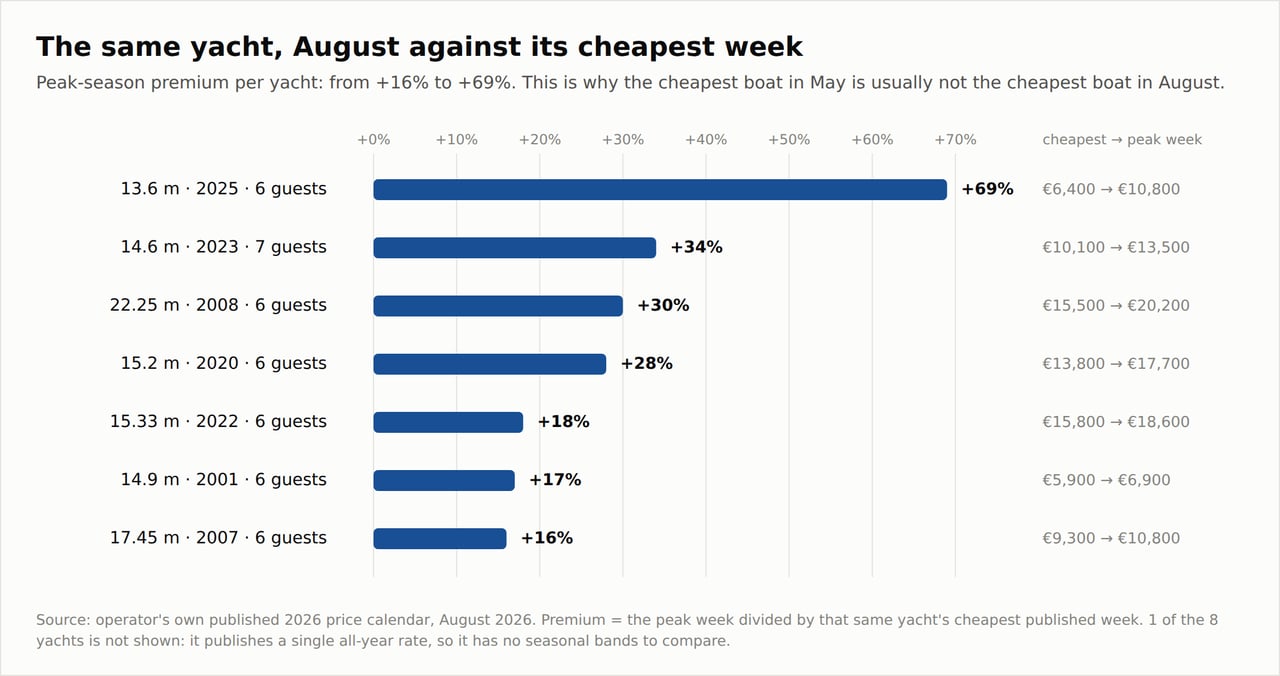
That spread is the single most exploitable thing in Croatian charter pricing, and it is invisible if you compare boats on one date. Take the two extremes. A 2025-built 13.6-metre boat and a 2007-built 17.45-metre boat both cost €10,800 in August — identical money, four metres apart. Move to the second week of June and they are €8,300 and €9,300. Move to May and they are €6,400 against €9,300. The new small hull is priced like a boat in demand; the older large one is priced like a boat whose owner would rather it were working in May than sitting.
Neither is a better deal in the abstract. One is a better deal in August and the other is a better deal in May, and no amount of negotiating changes that — it is baked into the calendar. If your dates are flexible, moving them is worth more than any discount you will argue for. If your dates are fixed, the job is finding which boat's curve is flattest on exactly those days, which is a search problem rather than a browsing problem.
You do not have to take the whole week
Every one of these eight boats carries a minimum charter duration of three days. Not seven.
This is the single most useful thing on this page for anyone who has been reading Croatian charter sites and quietly concluding that a yacht is a week-long commitment or nothing. It is not. A Thursday-to-Sunday on a 14-metre boat in the shoulder season is a real booking, not a favour, and it puts a crewed motor yacht inside the budget of a long weekend rather than a summer holiday.
The reason it is rarely advertised is structural: charter companies build their season around Saturday-to-Saturday turnarounds because that is what fills the calendar most efficiently, and short bookings punch holes in it. Short charters therefore tend to be available in the shoulder months and awkward in mid-August — which is exactly when the boats are cheapest anyway.
Three marinas, and the thing everyone gets backwards
Boats working out of "Split" do not all leave from the same place. Of the eight above, six lie at Marina Lav in Podstrana, one at Marina Zenta in Split itself, and the 22-metre boat at Marina Kaštela.
People assume that the marina named after the city is the one nearest the airport. It is the other way round.
Marina Kaštela is 11.2 km from Split Airport, and about 12 km from the city centre — roughly 25 minutes by the expressway. The airport is in Kaštela. The marina is next door to it. It has 420 berths.
Marina Zenta sits about a nautical mile east of Split's main harbour, essentially inside the city. You will be dropped at the boat by a taxi that has driven the length of the Split waterfront.
Marina Lav is 8 km south of Split, in Podstrana, and is therefore the furthest of the three from the airport — you drive past or through Split to reach it. It is a small, modern marina: 74 sea berths and 40 dry, taking vessels up to 40 metres, attached to the Le Méridien Lav hotel.
Practically, the transfer from your flight is shortest to a Kaštela berth, medium to a boat in the city, and longest to Podstrana — which is where most of the Split charter fleet actually lies. It is not a long drive by any standard. But on a Saturday in July, when the whole coast changes over at once and the Split ferry port is loading, "not a long drive" and "not a long time" are different sentences. Build in the difference rather than discovering it, and ask which marina a boat lies in before you commit to it, because it is almost never stated in a listing.
The other consequence is at the end of the week, not the start. If your flight is at 11:00 and your boat is at Lav, you are leaving the marina considerably earlier than a guest berthed in Kaštela. Ask which marina your yacht is in before you book the return leg, not after.
What twenty knots does to a Croatian itinerary
Here is the part that genuinely separates a motor yacht charter from the sailing charter most Croatia itineraries are written for, and it is arithmetic rather than opinion.
These boats cruise at 18 to 25 knots and top out between 28 and 35. A cruising sailing yacht in the Adriatic averages something closer to six. Take the classic Split-to-Dubrovnik run, which a published charter itinerary breaks into these legs:
Split / Kaštela → Maslinica, Šolta — 13 nm, 39 min at 20 knots
Maslinica → Komiža, Vis — 24 nm, 1 h 12
Komiža → Biševo → Vis town — 22 nm, 1 h 06
Vis → Palmižana → Hvar — 13 nm, 39 min
Hvar → Korčula — 25 nm, 1 h 15
Korčula → Pomena, Mljet — about 15 nm, 45 min
Mljet → Šipan/Lopud → Dubrovnik — about 25 nm, 1 h 15
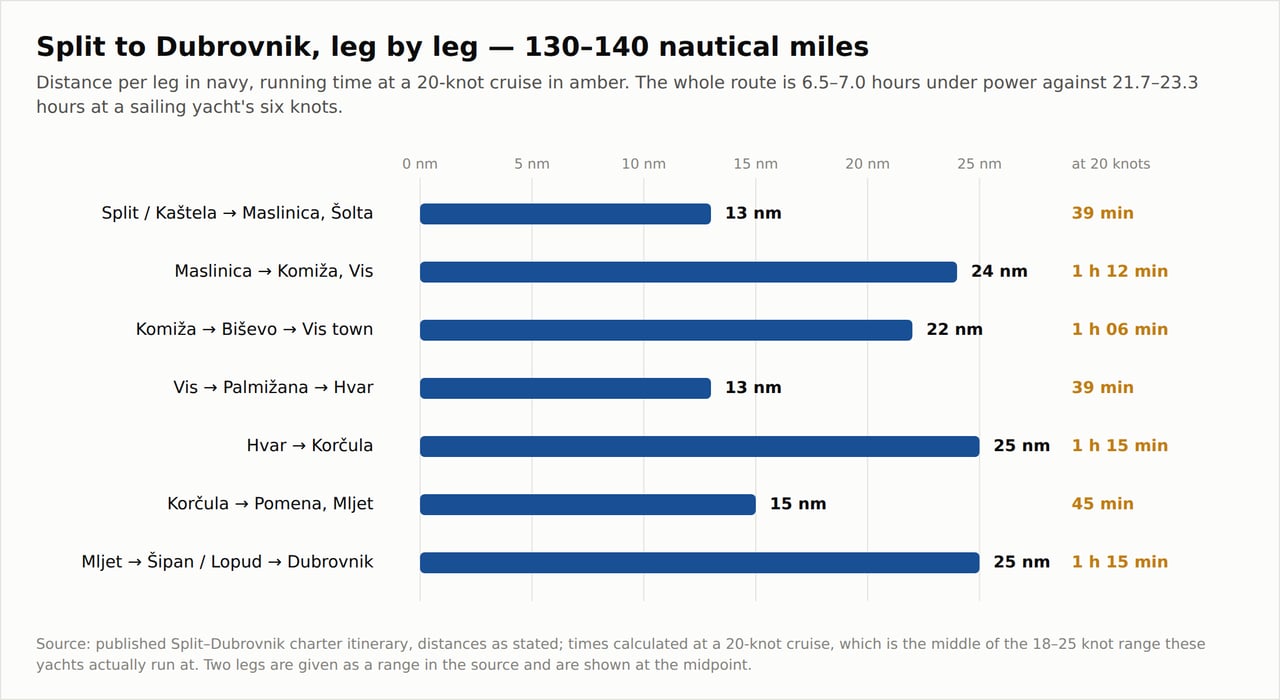
The whole route is roughly 130 to 140 nautical miles. Under sail at six knots that is between 22 and 23 hours of passage-making, which is why it is sold as a seven-day itinerary — three or four hours of sailing a day, and the islands are the gaps between them. At twenty knots the same distance is six and a half to seven hours. The entire week's sailing is one long day's running.
That does not mean you should do it in a day. It means the week stops being a route and becomes a set of choices. You can be anchored off Palmižana for lunch and tied up in Vis for dinner. You can wake in Hvar, decide the wind has gone wrong, and be somewhere else in Korčula before the afternoon. You can go to Mljet and come back. On a sailing yacht those are trade-offs; here they are just decisions.
Two limits keep it honest. The first is fuel: the boats carry between 1,000 and 3,900 litres, with published ranges of 220 to 280 nautical miles. A Split–Dubrovnik round trip is 260 to 280 nautical miles before you have moved sideways once, which is at or beyond the published range of four of the eight boats. That is not a problem — Dalmatia has fuel docks — but it makes refuelling a planned stop rather than an improvisation, and it is worth raising with the crew at the briefing rather than at the second-to-last island.
The second limit is that fast boats burn fuel to be fast, and fuel is not in the charter fee. Twenty knots everywhere is the most expensive way to use these yachts. The crews who run them all week tend to move at speed once a day and idle the rest.
Where the money goes beyond the weekly rate
The published week buys the yacht and the crew. Three other lines come with it, and they behave differently from one boat to the next.
Transit log. Where it is published in full it is stated at €700, covering final cleaning, bed linen, towels and Wi-Fi. It is the standard Croatian charter mechanism and every boat carries some version of it, so treat €700 as the shape of the number rather than a universal price.
APA — advance provisioning allowance. This is the float the crew spends on your behalf: fuel, berths, food, drink, park fees. On the two boats that publish one it is €5,000 on a 15.33-metre hull and €6,000 on the 22-metre. It is not a fee — whatever is not spent comes back to you at the end — but it is money you must have available at the start, and it is the single most common thing first-time charterers are unprepared for. Where no APA is published, expect to settle fuel and berths directly.
Security deposit. €5,000 where published, refundable, held against damage.
All eight yachts are VAT-paid, which matters if anyone in your group is comparing offers from elsewhere in the Mediterranean where that is not always true.
Then there are the costs that only appear once you are out. If your week includes the Kornati archipelago, the national park charges a daily ticket per vessel by length. For a boat in the 11–18 metre bracket — which covers six of these eight yachts — that is €50 to €95 bought in advance, and €95 to €190 bought from a ranger inside the park, with the range running from off-season to peak. For the 18–25 metre bracket, which covers the two largest, it is €80–160 in advance against €160–320 on arrival. Buying the ticket before you cross the park boundary halves it. Nobody tells you this on the water, because on the water it is too late.
What each step up in price actually buys
Read that price list as four tiers rather than eight boats, because tiers are what survive from one season to the next. Individual hulls come in and out of a market constantly; the shape of the money does not.
The entry tier, €5,900 to €6,900 a week. A 14.9 m hull built in 2001, 6 guests, one crew. This is also the flattest season curve you will find — a 17% peak premium — so it is the one tier where booking in August costs almost nothing extra. What you are giving up is build year and interior volume, not itinerary. It reaches the same islands as everything above it, at the same 20 knots, on the same three-day minimum.
The value tier, €6,400 to €10,800. Two very different propositions sit here and they cross over during the season. A new small hull — 13.6 m, built 2025 — is the cheapest thing on the water in May and costs exactly the same as a boat four metres longer in August, because new boats hold their peak pricing and older ones do not. A 17.45 m hull from 2007 barely moves across the calendar at all. In May the gap between the two is €2,900; in August it is nothing. Which of them is "better value" is entirely a function of your dates, not of the boats.
The mid tier, €10,100 to €17,700. Hulls of 14.6 m to 15.2 m built 2020 to 2023, and this is where specification stops being about age and starts being about layout — a flybridge, a third cabin, a seventh berth, 25 knots instead of 18. It is also the tier where the small questions decide the week. A boat that sleeps 7 may do it in 2 cabins rather than 3, which is a real consideration for a group of friends and a non-starter for two families. Ask how the berths are arranged before you assume a number solves your group.
The top tier, €15,500 to €21,200. Two different purchases live here. One is size: 22.25 m, two crew rather than one, 3,900 litres of fuel, 35 knots flat out — space and range, on a 2008 hull. The other is newness at 15.33 m, where the same model built a year apart differs by €2,600 in a peak week. That gap is the clearest illustration anywhere in this data of what a single build year is worth. At the top of the range, knowing which of those two things you are actually buying is the whole conversation.
The boat you found online is probably not the boat you will get
Every number above is real and every one of them will be out of date at some point, because published rates are the easy part. The hard part is availability, and availability is not a property of a boat — it is a property of a boat on your dates.
A crewed yacht in Dalmatia is committed a week at a time, usually Saturday to Saturday, from June onward. By March a good boat in the second week of August is gone. By June the calendar is a wall with a few doors in it, and those doors move daily as options expire and bookings fall through. You can spend an evening choosing between three yachts and find that none of the three was available when you started, and no listing site will tell you which.
The way round it is not a better shortlist. It is to invert the search: state what you actually need — dates, group size, roughly what you want to spend, and the one or two things that genuinely matter — and have someone check the market against that, rather than checking the market and then trying to make it fit you.
Done properly that is not a small job. Across the boats genuinely free on your week it means asking which layout suits who is sleeping where, which marina each lies in and what that does to your transfer, what the APA and transit log come to on each, and where the season curve falls on your exact dates rather than in general. Half of that is published nowhere. It comes from knowing the boats and calling the people who run them.
So the useful first message is not "is this yacht free?" but "here are our dates and our group — what should we be looking at?" That is a question that can be answered in a day. Send it as a search request with your week, your numbers and your budget, and the answer that comes back is a shortlist of what is actually bookable rather than a catalogue of what exists. If you would rather browse first, the charter fleet shows the specifications and photographs behind the tiers above.
The same search runs in the other direction too. A good number of people who charter three or four seasons in a row eventually ask what the boat would cost to own outright, and what it would earn back in charter while they are not using it. That is the brokerage side of the same market knowledge — the same weekly rates, the same season curves and the same running costs, read as a return rather than as a holiday price. It runs both ways — what buying one actually involves, and what it takes to sell a yacht well. It is a fair question to ask by the second or third year, and a cheaper one to ask early than late.
Frequently asked
How much does a yacht charter in Split cost?
Between €5,900 and €21,200 per week in 2026 for a crewed motor yacht sleeping six or seven. The cheapest published week is a 14.9 m hull from 2001 in the low season; the most expensive is a 15.33 m hull from 2021 in peak. Per guest on a full boat that is roughly €983 to €3,533 for seven nights.
Can I charter a yacht in Split for less than a week?
Yes. Every one of the eight boats above carries a three-day minimum, not seven. Short charters are easiest to place in May, June, September and October, and hardest between 20 June and 29 August when boats are committed to Saturday-to-Saturday weeks. Because the short slots are the ones that appear and vanish fastest, they are worth asking about rather than searching for.
Which marina in Split is closest to the airport?
Marina Kaštela, at 11.2 km — the airport is in Kaštela. Marina Zenta is in Split itself, and Marina Lav is 8 km south of the city in Podstrana, making it the furthest of the three from the airport despite being the base for most of the fleet.
How far can you get from Split in a week?
Dubrovnik and back, comfortably. The one-way route is 130–140 nautical miles, which at a 20-knot cruise is six and a half to seven hours of running — the same distance a sailing yacht spreads across a full week. Fuel range, not time, is the real constraint on a round trip.
What is not included in the charter price?
Fuel, berthing outside the home marina, food and drink, national park tickets, and the crew tip. These are usually settled through an APA — €5,000 on a 15.33 m boat, €6,000 on a 22.25 m one — which is a float you fund up front and get back unspent. The transit log, covering cleaning, linen, towels and Wi-Fi, is stated at €700 where it is published.
When is the cheapest time to charter from Split?
Before 29 May and after mid-September, where the same boat can be 16% to 69% cheaper than in peak. The saving is much larger on some yachts than others — the newest hull here drops from €10,800 to €6,400, while the oldest moves only from €6,900 to €5,900. Which is why the cheapest boat for your week is a question about your dates before it is a question about boats.